
Cleanup projects have a way of expanding. A “quick” garage purge turns into a whole-house cleanout. A small remodel becomes a multi-week renovation. And on active job sites, debris can pile up fast enough to slow work and create safety hazards. That’s why the decision between dumpster rental vs junk removal matters early before the mess becomes the bottleneck.
In simple terms, dumpster rental tends to fit projects that generate debris over time, while a junk removal service is usually best when everything is ready to go right now. The right choice depends on timeline, labor, space, and the kind of material being tossed.
This guide offers a practical waste removal comparison to help homeowners and contractors confidently choose waste solution options that match how the project actually runs day by day, not just on paper.
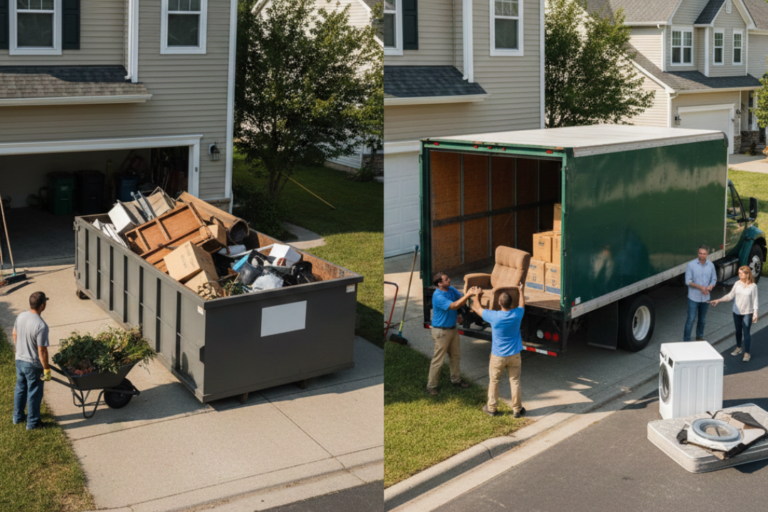
The easiest way to understand this decision is to look at how waste gets handled during the work, not just what’s advertised.
With dumpster rental, debris is contained in one dedicated spot throughout the project. That means tear-out materials, packaging, and day-to-day waste can be dropped in as they appear. This approach supports steady progress because cleanup happens continuously, not in a last-minute scramble.
A junk removal service works differently. A crew arrives at a scheduled time, loads the debris, and hauls it away in one visit. This is ideal when the cleanup is already finished, or when the customer wants minimal involvement in lifting and moving heavy items.
In most cases, dumpster rental assumes the customer (or crew) loads materials into the container. For contractors, that’s often a natural fit because labor is already on-site. For homeowners, it can be a good match if they’re working room by room and want flexibility.
A junk removal service is typically hands-on. The crew does the lifting, loading, and haul-away, which can be especially helpful for bulky furniture, heavy appliances, or situations where speed matters more than control.
People often ask, “Which is cheaper?” The better question is: “Which option stays cost-effective as the project changes?”

In many markets, container-based pricing is easier to forecast across a longer timeline, especially when debris arrives in phases. That predictability is one reason contractors lean toward dumpster rental for remodels, roofing, and construction.
Haul-away pricing often depends on how much the truck gets filled and how much labor is involved. A small pickup may be affordable, but larger loads can scale quickly. That’s why a junk removal service can be a great value for a limited, well-defined cleanup especially when the customer wants everything gone at once.
A strong waste removal comparison should account for more than the invoice. It should consider:
The “best” option is the one that keeps the project moving with the least disruption.
Even when budgets are similar, logistics often decide the winner.

For longer renovations and active job sites, the ability to dispose of debris continuously tends to reduce downtime. That’s where dumpster rental vs junk removal becomes a timeline question as much as a disposal question.
If the project is short, or the debris is already staged and ready, a junk removal service can restore the space quickly, often within a single appointment window.
Space matters. A container needs a suitable place to sit, and delivery access needs to be clear. When placement is simple and the job will generate debris for days, dumpster rental often fits the workflow well.
Haul-away crews need access too, but they don’t require the customer to reserve space for equipment over time. That’s why a junk removal service can work well for tight properties, quick turnovers, or situations where keeping the driveway clear is a priority.
A helpful rule of thumb: if debris will show up in waves, ongoing access tends to make life easier. If everything is already piled and ready, immediate removal can be the cleanest path. This is where homeowners often choose waste solution options based on time and convenience, not just cost.

Comparisons are easier when the decision is structured. The following checklist keeps the choice practical
In a typical dumpster rental vs junk removal scenario, a container-based approach is often best when:
A haul-away option often wins when:
This final waste removal comparison comes down to the project’s rhythm:
For both homeowners and contractors, using that lens helps them choose waste solution options without overcomplicating the decision.
Taconic Carting and Hauling Inc. works with both homeowners and contractors to match service to real job conditions. Instead of forcing a one-size-fits-all approach, the team helps customers evaluate timeline, debris type, access constraints, and disposal needs.
When a project calls for staged disposal and a dedicated place for debris, Taconic can support customers with dumpster rental that fits the job scope. When the priority is fast removal with minimal involvement, a junk removal service may be the better fit. For customers weighing dumpster rental vs junk removal, having a local provider explain the tradeoffs makes the decision simpler and the outcome smoother so customers can choose waste solution options that keep the project moving.
For projects that require ongoing disposal access, a dumpster rental is often the right fit. When materials are ready to be removed in a single load, junk removal may be the more efficient option. Taconic Carting and Hauling Inc. evaluates project scope, timeline, and site setup to determine the disposal approach that best supports clean, efficient progress.
Request a disposal assessment to confirm the right service and schedule the option that aligns with your project requirements.